Search this blog

Translate

Showing posts with label Indian. Show all posts

Tuesday, August 8, 2017

Methi & Chard Gotas with Kadhi

I was finally able to recreate one of my favorite Gujarati recipes after growing my own fenugreek leaves from seeds.
They are actually quite easy to grow, very low maintenance, and quick yield.  They'll grow indoors if it's cold in the winter and replenish the outside soil with nitrogen, so it's nice to grow them in several places one after the other to prepare the soil for something more needy afterwards.
I got garden side-tracked.
I've had these growing up, had them in India, and most recently had them in New Jersey every day for breakfast...which I really looked forward to each morning.
Instead of making me tired of it, it actually sparked my desire to make them myself.
Of course, sourcing the methi (fresh fenugreek leaves) is the hardest part.  You can't just go to the store and buy a "bunch" of methi like you would buy a bunch of cilantro or parsley.  Even cilantro is not always guaranteed here (I just grow that too).
My methi leaves are still a bit too small, but I felt I needed to make this right away because I wanted them RIGHT NOW.
So, I added some finely chopped swiss chard greens (also from the garden).  I have a different thinner Kadhi recipe here as well.  This Kadhi is thick like a dipping sauce.
Serves 2 as a meal, 4 as an appetizer
Ingredients

For Gotas:
1/2 cups packed methi leaves, finely chopped
1/4 cup packed chard leaves, finely chopped
1 green chile, coarsely chopped (add more if you like it extra spicy)
1/2 inch ginger, grated
1 tsp sugar
1/4 tsp turmeric
1/4 tsp ground cumin
1/4 tsp ground coriander
1/4 tsp chili powder
1/4 tsp garam masala
pinch hing (asafoetida)
juice from 1/2 lime
1/4 tsp salt or to taste
1 1/2 cups besan (chickpea flour)
3/4 cups water
1/4 tsp baking soda
Vegetable oil for frying

For Thick Kadhi:
1 1/2 cups buttermilk (half yogurt, half milk)
1 cup water
1/4 cup besan (chickpea flour)
pinch turmeric
1/2 tsp mustard seeds
1/2 tsp cumin seeds
pinch hing (asafoetida)
1 slit green chile
1 sprig curry leaves
pinch of salt
cilantro to garnish
2 Tbsp vegetable oil
Directions

For Gotas:
1.  Mix all the ingredients together gently until it forms a thick mixture.  It shouldn't be liquidy, but shouldn't be dry either.  You should be able to spoon it and have it slowly drip off.
2.  Heat the oil.  You dont need a deep fryer but you need a deep enough layer so the gotis can be submerged.
3.  Carefully spoon 1 heaping tsp of mixture into the oil at a time, frying until it turns golden, then removing with a slotted spoon onto a paper towel.

For Kadhi:
1.  Heat the oil in a wok or tadka or deep sautée pan.
2.  Add the seeds and cook until they crackle, then add the turmeric and hing.  They should fizz.
3.  Add the slit chile and curry leaves and fry for about 1 minute.
4.  Add the besan and buttermilk and cook, whisking until it thickens.  The buttermilk might separate but it's ok.
5.  Add water until the mixture reaches desired thickness.  Add salt to taste and garnish with cilantro.

For eating:
Either pour the kadhi all over the gotas and eat them one by one on your own plate...
or
keep it communal and use the kadhi as a dip..
Either way, enjoy and wish you had made more..

Print Friendly and PDF

Sunday, December 11, 2016

Tandoorified Cauliflower "Steak"

Does that mean you can make thick slices of cauliflower that don't fall apart and grill them?
I cannot believe how much diversity you can find in vegetables!  This is one of my many gifts this week.  But this one, I procured for myself.
(The other ones were indoor skydiving, a dinner cruise, and the new Steve n Seagulls album).
So, the only downside is that you can only make 2 "steaks" out of 1 cauliflower head.  The rest are just florets.. but I'll tell you what to do with those.. it's actually not really a problem.
Serves 2 steaks + 2 servings of florets
Ingredients
1 head cauliflower (mine was green cauliflower)
2 tsp tandoori spices
2 Tbsp olive oil
juice from 1/2 lime
chopped cilantro for garnish
Directions
1.  Make the slices.  Remove the outer leaves of the cauliflower head without cutting the stem.  Place it upside down on the cutting board, stem up (like a head stand) and slice right down the center of the stem to have 2 halves.. like a human brain.  Then slice each half once more, making a 1.5 to 2cm steak with each half.  The rest will break off as florets.  Keep those aside.
2.  In a saucer, stir the tandoori spices and olive oil together.  Brush this mixture generously all over the steaks.  Toss the rest of the mixture with the florets.
3. Take care of the florets.  Preheat the oven to 400°F 200°C.  Squeeze just a touch of lime juice over the florets, place them in an oven proof dish or sheet pan, making sure they are well separated, and bake for about 25 minutes.
4.  Now for the steaks.  Heat up your grill, plancha, or griddle pan to high heat.  Grill the steaks for about 2-3 minutes on each side, until they start to get grill marks.  Drizzle a touch of lime juice will this is happening.
5.  Remove from the grill/plancha/griddle and place in the oven.  I griddled on a cast iron skillet and just transferred the skillet to the oven.  Cook for about 15 minutes.  This will have the outside crispy and charge and the inside tender enough without being mushy.
This is perfection.
6.  Serve the steaks drizzled with lime juice and chopped cilantro.  The florets can be served the same way, but without the "steak" look.
I served mine with some Toor Dal, basmati rice, and some sauteed spinach.

Let me tell you about that spinach real quickly.
I took some nigella seeds (also known as black onion seeds) and threw them into some hot olive oil, then added some sliced garlic, and then threw in the spinach and cooked until it wilted.  Then I seasoned with a bit of fleur de sel and added 1 Tbsp dried pomegranate seeds for crunch.
I don't know where that idea came from, but it was a great idea and nicely complemented the rest.

So about those steaks.. there is something ultimately satisfying about tandoorifying vegetables.  The char marks from the grill give the veggies that superior dimension and tandoori spices complement that texture perfectly.
The result is eye-candy.. we rarely see the cross-section of cauliflower heads, nature is truly beautiful.

Print Friendly and PDF

Sunday, October 9, 2016

Mixed Vegetable Korma

This weekend, I needed a taste of India.
Fresh curry leaves have been located somewhere in Lyon, but I don't know exactly where... all I know is they made their way into my hands.
For as long as I have been cooking Indian food (which means a reasonable number of years) I've been longing for curry leaves.  When I first went to India I tried to source some but I didn't know what to call them in Hindi.  Now I know, it's Kadi Patta.  But over there, they sold me Tej Petta which I later figured out are bay leaves.  I thought all was lost when I finally discovered the Indian supermarket in Lyon where they (sometimes) carry dried curry leaves in little baggies.  After cooking with them for the first time, I became enamored.  They add such a distinct flavor to daals and vegetable stir fries, they're almost like a secret ingredient, unable to be replaced or substituted.  They were my little best kept secret... until I was told that they were seen fresh in town.
Fresh curry leaves?  But they grow only in hot climates and only stay fresh for a few days!  How can this happen in Lyon?  Everyone I know that cooks with fresh curry leaves doesn't buy them.. they grow them.. in India, California, and Malaysia.. never in France.
So when they were gently handed to me as proof that when you really long for something, it becomes reality, I may have concealed my happiness in order not to make a scene in public.
This offering surpasses all others.
This offering is more than just a thing, this is the deepest understanding of my desires.
Thank You.
Inspired by VegRecipesofIndia
Serves 6-7 as a side
Ingredients
Spice paste:
1 inch piece cinnamon stick
2 cloves
1 tsp fennel seeds
1 green cardamom
1/2 Tbsp coriander seeds
2-3 dried red chiles, deseeded
1 tsp poppy seeds
6 Tbsp grated coconut
6-8 cashews
1/2 Tbsp chickpea flour
4 cloves garlic, chopped
3/4 inch piece ginger, grated
1/2 cup water for grinding
Korma:
3 Tbsp oil
1 onion, chopped
1 tsp freshly grated turmeric
2 sprigs fresh curry leaves
spice paste
1 carrot, peeled and chopped
1 large tomato, diced
2 large handful fresh green beans (about 1 cup), tailed and cut in half crosswise
1 handful snap peas
1 1/2 cups cauliflower florets
1 red bell pepper, sliced
1 cup water
2 Tbsp yogurt (optional)
salt to taste
chopped cilantro for garnish
Directions
1.  Make the spice paste.  Dry roast the cinnamon, cloves, fennel, cardamom, coriander seeds, chiles, poppy seeds, and cashews until fragrant, then add the coconut, and chickpea flour and dry roast a few more seconds.  Transfer to a blender with the rest of the spice paste ingredients and grind into a thick paste.  Set aside.
2.  Prepare the Korma.  Heat the oil in a wok or heavy based pan, then add the onions, turmeric, and curry leaves.  Cook until onions are translucent.
3.  Add the spice paste and fry while stirring, making sure it doesn't burn.  
4.  When the oil starts to separate, add the carrots, tomatoes, and 1/4 cup water.  Cover and simmer for about 10 minutes.
5.  Add the rest of the vegetables along with a few pinches of salt.  Cook on medium heat, stirring for another 15 minutes.  Add water as needed.
6.  Before serving, stir in 2 Tbsp plain full fat yogurt.  This step is completely optional and only adds decadence to the dish.  It is perfectly delicious without the yogurt.  Heat through, then remove from heat.
Serve hot or warm topped with chopped cilantro.

I served mine in a thali along with some saffron basmati rice, toor daal, rotis, and some whole roasted tandoori chicken.
Now I just need to get the intel on where exactly to find these next time... for everyone has their secrets and this one was not shared with me...

Print Friendly and PDF

Monday, August 22, 2016

Aloo Gobi with Broccoli and Mutter Sabzi

India has been calling me by my first name recently.
She's been putting ideas into my brain, marinating them all day, then releasing them on the weekend.
I never get bored chit chatting with the Ba's from different regions.. in my head..

Loosely inspired by TheChefandHerKitchen.
Ingredients
1-2 Tbsp oil
1 tsp cumin seeds
pinch hing (asafoetida)
1/4 tsp turmeric
1 green or red chile, slit
1 onion, chopped
1 tsp grated ginger
1 tsp grated garlic
1/2 small head broccoli, cut into florets
1/2 small head cauliflower, cut into florets
2 medium potatoes, steamed, peeled, and cut into large cubes
1/2 cup green peas
1 tomato, chopped
1 tsp ground coriander
1/2 tsp ground cumin
1/2 tsp garam masala
1/2 tsp amchur (dried mango powder)
1/4 tsp chile powder
1 Tbsp besan (chickpea flour)
pinch salt
chopped cilantro for garnish

Directions
1.  Heat the oil in a wok or heavy based pan.  Add the cumin seeds and wait until they start to crackle, then add the hing and turmeric.  They should fizz.
2.  Add the slit chile and chopped onion and cook until onion is translucent, then add the ginger and garlic and cook for another minute, stirring.
3.  Add the broccoli and cauliflower florets and stir.  Cook for about 5 minutes until almost tender, then add the potatoes and peas.
4.  Cook on high, stirring, for another 2-3 minutes, then add the tomatoes.
5.  Mix the ground spices and besan together and sprinkle all over the vegetables.  Mix gently, then remove from heat and cover.
6.  Let sit for at least 5 minutes before serving.

I served mine topped with chopped cilantro with Kala Chana Masala, Basmati rice, and Rotis.

Print Friendly and PDF

Sunday, July 10, 2016

Onion, Cabbage and Coconut Tart with Cilantro Chutney

During my bouts of kitchen schizophrenia (yes I talk to my vegetables and yes they talk back to me), I couldn't bring myself to make any sensible clean cut decision.  I was to have some of my favorite French people over for an Appetizer Soirée and needed several ideas.  Usually, when I do this, I stick to a basic theme.  This time, I wanted it all.
All of it.
It was going to be my united cultures party.
And of course, since the only thing that was missing was the French flag, I put India in a quiche.
Just Brilliant.
I may not have invented the idea, but this recipe is 100% my own.

Serves 6 - 8 as an appetizer
Ingredients
Shortcrust:
100g (3.5 oz) butter
1 Tbsp nutritional yeast
1/2 tsp chile powder
1 tsp amchur (mango powder)
1/2 tsp turmeric
1/4 tsp salt
100g (3.5 oz) buckwheat flour
120g (4.2 oz) whole wheat flour
1 egg yolk
5 cL water
use the method, then pre-cook for 10 minutes at 190°C 375 °F
Filling:
2 Tbsp olive oil
2 tsp mustard seeds
3 dried red chiles
(if I had curry leaves, I would have added them)
1/4 tsp hing (asafoetida)
1/4 tsp turmeric
4 onions, sliced thinly
1/4 head cabbage, shredded
1/2 cup shredded coconut
few pinches salt
3 small eggs or 2 large
10 cL (3.5 oz) coconut cream
1/2 inch grated ginger

 Directions
1.  Heat the oil in a wok or heavy based pan
2.  Add the mustard seeds and wait for them to crackle before adding the chiles and curry leaves.
3.  Add the hing and turmeric.  They should fizz.  I love that part.
3.  Add the onions and cook on medium-high heat for about 10 minutes, stirring.  You want them to slightly color.
4.  Add the shredded cabbage and a few pinches salt.  Cook, stirring, until onions are nice and golden.
5.  Add the shredded coconut and cook, stirring, for another 2-3 minutes.  The dried coconut gets toasty quick, so be careful not to burn it!  Taste, adjust the seasoning, remove the whole chiles so you can add them to your own slice later on, and remove from heat.
6.  While this is happening, whisk together the eggs, coconut cream, and grated ginger.
7.  In your pre-heated shortcrust, lay the onion-cabbage-coconut mixture down and pour the egg mixture evenly over it.
8.  Cook at 180°C 350°F for 35 minutes.. then let it cool down for at least 30 minutes.
Best served warm with some chutney.... the crumbly crust will melt in your mouth and subtly caress your senses.
Who knew this could actually work?
The next day, I had a slice in my thali with some Daal, Urad Pakoras, Papadums, and Cilantro Chutney.
Are you drooling yet?
I am...

Print Friendly and PDF

Sunday, April 10, 2016

Bella Capsicum Masala with Tandoori Eggplant

When I go Indian... I must make Thali.  I LOVE having several flavors and colors in my plate.
I do go overboard on quantities sometimes, which means I get to eat this several times during the week.
Who's complaining?
The new additions to my thali this time are the Tandoori Eggplant the Bella Pepper Curry.  The Sexy Dal and Red Cabbage Subzi are very common guests in my home.  I was looking for something veg but saucy enough to eat with rice.  When I found that Bells could be the main event, I swooned.
I may have swooned aloud around folks that had no idea why I was swooning.. but that's ok..
Borrowed from VegRecipesofIndia (as usual).
Serves 6 as a side
Ingredients
Paste:

2 large onions,  chopped
1 inch ginger, sliced
5 garlic cloves, chopped
3 tbsp desiccated coconut
2 tbsp peanuts
1 tbsp sesame seeds (I used black)
1 tbsp coriander seeds
1 tsp poppy seeds
2 tbsp oil
2 tsp concentrated tamarind or tightly packed seedless tamarind
½ to ⅔ cup water for grinding
Curry:
2 tbsp oil
½ tsp black mustard seeds
1/4 tsp fenugreek seeds
1 sprig curry leaves
1 tomato, chopped
4-5 medium different colored bell peppers (capsicum), sliced
⅛ tsp turmeric powder
1 tsp red chili powder
½ tsp garam masala powder
1 to 1.25 cups water
½ tsp powdered or grated jaggery or add as per taste
salt as required
chopped cilantro for garnish

Directions
Make the spice paste:

1.  Heat 2 tbsp oil in a pan and fry the peanuts, sesame seeds, coriander seeds and poppy seeds on a low flame for 3 to 4 minutes.
2.  Add the ginger and garlic and let cook for 1 minute before adding the onions.
3.  Cook, stirring until the onions turn translucent or a light brown, adding a pinch of salt.
4.  Add the coconut on low flame and continue to stir for 7 to 8 minutes, till the coconut turns golden. The whole mixture should turn light golden or golden.
5.  Let cool, then blend with the tamarind and enough water to make it into a paste.  Set aside.

Make the curry:

6.  Wipe down your pan and add oil on high.  Add the mustard seeds until they crackle, then add the fenugreek and curry leaves and cook for 1 minute.
7.  Add the chopped tomates and a pinch of salt.  Cook until the tomatoes soften.
8.  Add the sliced bells.  Cook stirring, for about 3 to 4 minutes.
9.  Lower the flame and add the paste along with the turmeric and chili powder.  Cook stirring for about 2 minutes, making sure the paste does not stick to the pan.
10.  Add 1 to 1.25 cups water and stir until incorporated, then add the jaggery and garam masala and simmer on low for about 15 minutes for softened bells.
Serve hot garnished with chopped cilantro. 
I served mine in a vegetarian Thali.
Yes that is tandoori eggplant... which is basically an eggplant halved lengthwise with criss-cross cuts into the flesh, slathered with lemon juice, tandoori spices, and olive oil.. then roasted until tender.
That was the Umami part of the fabulous evening.
Anything can be tandoorified (even endives!), making it shine in a very sexy light..

Print Friendly and PDF

Monday, March 28, 2016

Tandoori Endives with Madras Coconut Fish

A Desi Rani's meal with exotic fusions.
The exotic part of this meal is the totally French endives seasoned and grilled the North Indian way... tandoori style, of course!

Print Friendly and PDF

Thursday, November 5, 2015

Tandoori Roasted Eggplant with Pear

Sometimes I have different cravings at the same time.  Those days I just zone out and put my inner cook on autopilot.  Sometimes the result is ok, but not breathtaking.
This time it was a masterpiece.
The balance, between textures, spiciness, sweetness, and Indianness makes it so perfect I wouldn't be surprised if I was served this as an appetizer at a classy restaurant.
I wanted eggplant but had some leftover chutney that needed to be used up.  I only needed to cook for myself so I set myself free and let it happen.  I took my desired eggplant, sliced it, rubbed with tandoori spice and then found a pear that had been hanging out in the fridge for a while and decided to do the same with it.  The worst that could happen would be if cooked pear and tandoori didn't go together.
What happened?
Ultimate witchcraft.  A mesmerizing state of mind during the enjoyment process.  Something I had to absolutely document so I can make it again and serve it to actual humans...
Serves 2-3 as an appetizer
Ingredients
1 large eggplant, cut into 4-5 lengthwise slices
1 pear, peeled, cored, and cut into wedges
1 green chile, split
1 1/2 tsp tandoori spice
1 Tbsp olive oil
Directions
1.  In a baking dish, rub the tandoori spice all over each slice of eggplant, pear, and green chile, then toss with the olive oil.
2.  Spread out in one layer and roast for 30 minutes at 200°C 400°F.

Serve with Spicy Cilantro Chutney

or do it again with Persimmons, and Zucchini instead of pear
and serve as a "real" meal with basmati rice and dal.

I had the entire thing for dinner because I could not stop myself from savoring each and every little piece.  Each bite is an adventure in itself.. and with the chutney you skyrocket off your seat.
I cannot wait to make this for company.
It is a high class appetizer.. plus, I won't be offended if you eat it with a knife and fork..

Print Friendly and PDF

Monday, November 2, 2015

Beetroot Pakoras

This weekend I was invited to a party and asked to bring an appetizer.  That news in and itself was thrilling and got my gears churning all week to figure out what to make.
I was told to stay within reasonable limits because it was to be served alongside a gratin dauphinois....
That completely blocked my gears.
All I wanted to do was make Lobia Pakoras with chutney and now I find out it has to go with a potato and cream casserole.  How in the hail am I supposed to make something that crazy happen?
Well, lets see.. since a gratin dauphinois is pretty heavy, I should make something light with vegetables.  Ooh beet pakoras!  PERFECT!
All I had to do was present them as beet fritters with cilantro "coulis" to make it sound local enough to psychologically be paired with whatever was going to be served.
After 2 days of trying to find a "French-ish" recipe that I could be proud of, I found the absolute perfect way to break the ice... Indian style.
Original recipe from Padma'sRecipes.
Yield 22 pakoras
Ingredients
1/2 cup toor daal, soaked overnight
1/2 cup chana daal, soaked overnight
1 medium beet, peeled and grated (about 1 cup)
1 large carrot, peeled and grated
1 green chile, finely minced
1 red onion finely minced
1 inch piece ginger, grated
1 sprig curry leaves
2 pinch hing
1/2 tsp salt
sunflower oil to fry
Directions
1.  Drain the daals and grind them with the hing, salt, and curry leaves into a paste.  It shouldn't be an evenly smooth paste.
2.  In a mixing bowl, stir together the dal paste and the vegetables.  Knead until everything is evenly distributed.  I pulsed my hand blender in the mix a few times to help it come together.  It should not be goopy or watery, but if you form a ball with your hands it should stay together.
3.  Heat the frying oil.  Make balls and press them tightly together.  Carefully drop the balls into the hot oil.  Do not overcrowd.  You should have enough oil to almost cover the pakoras.
4.  Cook 3 minutes, then flip and cook another 3 minutes.  They should be golden and crispy.  Reserve onto paper towels.
5.  Reheat if needed in the oven for 10 minutes so they keep their crispiness.

I served with a duo of Spicy Cilantro Chutney and Sweet Tamarind Chutney.

This was a great success.  Although they were fried, they were light and crunchy and went perfectly with both chutneys.  The Sweet Tamarind actually enhanced the flavor more than the Spicy Cilantro.. but I can eat that one by the spoonful whether or not there are pakoras or samosas!  I was asked for the recipe.  WIN!
I'm very happy I didn't listen to the "advice" about staying French.  If I have something on my mind, you can't ask me NOT to do it.  The human brain just does not work that way.

Print Friendly and PDF

Sunday, October 18, 2015

Mushroom "Butter" Masala

I first made this as a test, just because I was craving mushrooms.  That day my camera was not functioning so I did not snap a shot of it.  I then made it for my best friend while she was visiting from San Diego.  We were so caught up in the action that I just completely forgot to snap a shot.  That day was amazing.  I learned to share my kitchen with others in a symbiotic way.  That day, cooking became more of a social activity than an individual therapy.  There are times when the journey is just as important as the destination.  I don't think there are many people with whom I would feel comfortable enough to cook with.. but this friend is like a part of me.  We've been through enough together to give her an open view into any part of my strange pathologies.  That day was so pleasant that I absolutely had to try it again.. because if I ever crave it again and I don't document it, how will I ever find the recipe again?
I freestyle so often that when something is perfect, I must absolutely photograph it and write it down so I can replicate it.. otherwise I'll just divert it into something else, which would still be good, but it wouldn't be THIS.
Serves 4-5 in a thali or 3 as a main dish
Ingredients
3 tomatoes
20 unsalted cashews
4 cups boiling water
3 Tbsp coconut oil (or butter or ghee)
1/2 tsp cumin seeds
1 tej petta (Indian bay leaf)
1/2 inch stick cinnamon
2 green cardamom pods
2 cloves
2 dried red chiles
1 onion, diced
350g button mushrooms, sliced thickly
1/8 tsp turmeric
1/2 tsp coriander powder
1/2 tsp chile powder
1 cup water
salt to taste
2-3 Tbsp coconut cream (or regular cream)
1/4 tsp garam masala
1/2 tsp methi (fenugreek leaves)
garnish:
fresh ginger cut into strips
chopped cilantro
Directions
1.  Make the cashew tomato paste.  Place the tomatoes and cashews in a bowl and pour the boiling water over them.  Let sit for at least 20 minutes, then drain, blend into a paste, and set aside.
2.  In a wok or heavy based dish, heat the coconut oil and add the cumin seeds, bay leaf, cinnamon, cardamom, cloves, and dried chiles.  Cook until the cumin starts to sputter.
3.  Add the onion and cook until translucent.
4.  Add the mushroom slices and cook on high, stirring, until glossy.
5.  Add the turmeric, coriander powder, and chile powder, then add the cashew-tomato paste.  Cook until it thickens and reduces.
6.  Add the water and stir, then simmer on low for 7-8 minutes.
7.  Add the cream, garam masala, and dried methi.  Cover and switch off the heat until ready to eat.
8.  Serve garnished with chopped cilantro and ginger strips.
I served mine in a thali with some Sweet Potato Panch Poran, Tandoori Okra, Whole Mung Dal, basmati rice, and rotis.
This dish must have taken it's toll on me because I made it during another kitchen activity session with a new friend.  I feel this is the beginning of a lovely adventure...

Print Friendly and PDF

Sunday, September 20, 2015

Panch Poran Zucchini and Butternut Masala

There are days when I try very hard to cook this way.. And there are days when I find myself unable to cook any other way.  Those are the days when I know I want moong beans, for example, and that's it.  I have to rummage my way around my fridge and pantry to work around that one urge.. Because When I want moong, I want the whole experience.  My brain goes into autopilot and I become the puppet of my subconscience.  Today, I surprised myself as I sat down to enjoy my mung dal that all these other friends had come to enjoy the party.. Especially Mr. Zucchini.  That fellow has never come to join my India evenings.  Today, my Id must have done some coaxing for him to join us.. And I'm very happy he accepted the impromptu invitation!
Serve 3 as a side
Ingredients
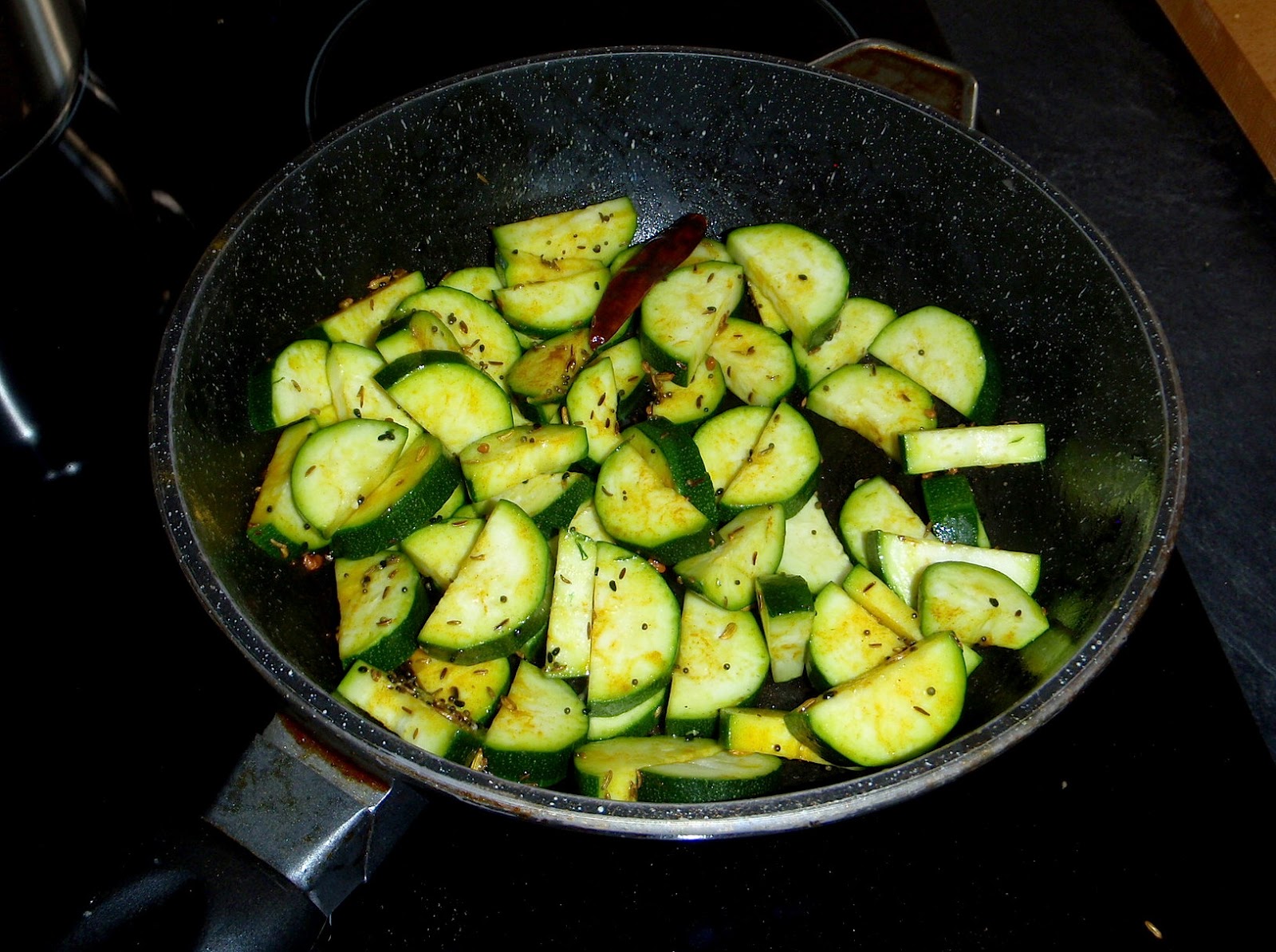
2 large zucchini, sliced lengthwise, then into 1/4 inch thick moons
1 Tbsp coconut oil
1/2 tsp cumin seeds
2 dried red chiles
1/4 tsp mustard seeds
1/4 tsp nigella seeds
1/4 tsp fenugreek seeds
1/4 tsp fennel seeds
1/4 tsp turmeric
1/2 tsp amchur (mango powder)
Juice from 1/2 lime
Pinch chile powder
Fleur de sel, to taste
1 cup cubed butternut squash (mine was already roasted)
Chopped cilantro for garnish
Directions
1.  Heat the oil in a wide heavy based pan (sautée pan).  Add the seeds and red chiles and cook for about 1 minute or until they crackle and sputter.  This mixture of seeds is called Panch Poran.  I like that name.
2.  Add the zucchini slices and stir to coat.  If your butternut squash is raw, add it as well.  If it is already cooked, wait until the end to add it.
3.  Cover and cook on high for 2-3 minutes.  During this time, the zucchini and squash will steam a bit while keeping some texture.
4.  Uncover and cook, stirring for another 3-4 minutes on high.  If your butternut squash is was already cooked, now is the time to add it.
5.  Add the lemon juice and mango powder along with a few pinches fleur de sel.  Stir and set aside until ready to serve topped with some chopped cilantro.

I served this with some Hara Moong Dal, Cabbage Sambharo, Turmeric Basmati Rice, and Rotis.

The whole deal was lovely but what I liked about this recipe is that the zucchini keeps its texture and does not melt down into complete mush.  Mr. Zucchini can be quite seductive when he puts his mind to it..

Print Friendly and PDF

Saturday, September 12, 2015

Roasted Sweet Potatoes with Tandoori Bok Choy

Cilantro chutney is my favorite type of leftover sauce with which to improvise.  I always make a big enough batch so I can either eat it with a spoon or find a creative new way to pair it.  It surprisingly goes with anything.. samosas, pappadums, steamed dhokla, chicken, fish, grilled or roasted vegetables, tortilla chips, bread.. my finger.  I even tried it with steak!  Sacriledge.. but who really cares.  That's not the point.  What I love is that the pairing sometimes completely blows me away.  When I make it for samosas, I know exactly what the outcome will be.. and that's good because it's exactly what I'm expecting.  Today I paired it with some roasted sweet potato slices.
Wow.
I don't think I can ever eat sweet potatoes without them.  They are like soulmates.. completely in contrast but beautifully symbiotic.  The sweetness of the sweet potato contrasts the harshness of the raw green.  With a little bit of coconut, it comes out as an incredible vegan main dish.
Since I was going for improvisational pairing, I decided to go completely vegan and pair this with a green veggie instead of meat.
After coming home from the Indian Wonderland Market downtown, my tandoori packet wanted to fuse with my blood cells.  It is made with all natural ingredients and no food coloring, but has a deep red color from the ground chiles.  If I didn't use it tonight, I would have snorted lines of it.  Tandoori seasoning smells so familiar it's aroma is like a sensual whisper.  It also goes well with grilled veggies.  I've done broccoli and cauliflower with very happy endings.. so grilled bok choy seemed like an interesting successful combination.
This meal was so simple to put together but so perfect in its uniqueness that I couldn't let it go without properly documenting it.

Cilantro Chutney - yield 1 1/2 cups
3 green onions
1 green chile
1/2 bunch cilantro
4 cloves garlic
juice from 1 lime
4 whole black peppercorns
1 tsp oregano
pinch fleur de sel
Blend it all together

Roasted Sweet Potatoes - serves 1
1 sweet potato, cut into 1/4 inch slices
2 Tbsp olive oil
pinch fleur de sel
1 tsp amchur (dried mango powder)
1 Tbsp dried coconut for garnish
Toss with olive oil, fleur de sel, and amchur.  Bake at 200°C 400°F for 30 minutes, then serve garnished with some cilantro chutney and coconut.

Tandoori Bok Choy - serves 1
1 medium bok choy, sliced in half lengthwise
pinch fleur de sel
1 tbsp olive oil
1 clove garlic, grated
healthy sprinkling tandoori spices (about 2 tsp)
Rub the bok choy halves with the grated garlic, making sure to get the garlic into the crevices.  Sprinkle with fleur de sel and tandoori spices, then drizzle olive oil onto the open halves, rubbing it all over the bok choy.
Heat a griddle pan or cast iron pan on high, then grill the bok choy face down for about 3-4 minutes.  It should have nice char marks.  Flip them over and grill another 3 minutes.

This seems like a light meal, but it was very filling and satisfied all my longing senses without having to cut lines of tandoori powder and inhale them...

Print Friendly and PDF

Saturday, August 29, 2015

Roasted Ladyfingers

Okra has always had a special spot in my heart.  I grew up eating it in the US, but unlike most Americans, I always ate it as a Gujarati dish.  I had it only once the American way in Louisiana in a Gumbo, which was intriguing to me and also very tasty.  I had it again several times in India as a subzi with the Father.  We happily realized we were the only 2 of the group wild about okra so we didn't have to share as much.  There is something about those little pods that make me wild.  I love their cross section.. I love the way their seeds are round and full of wetness.
I also love the way they can be completely transformed by a small gesture.
Example:  Stir too often on stovetop and they will conserve their slime.
Add acidity and the slime will be dissolved
Add salt during cooking and slime will be enhanced
Bake, stuff, or fry.. and be transported to another land...
 To a non-believer, okra pods might look like a chile.  This is a normal remark for someone not familiar with chile other than in a hot sauce bottle.  In the photo above, you can clearly see that it has nothing to do with chile.  A chile contains capsaicin (the heat effect) and is from a completely different family.  Okra is a seed pod of the mallow family of flowering plants.  No heat, just texture and vitamins!
You know they've got to be a naughty vegetable when they are also known as Ladyfingers.  We all know what lady's fingers can procure..
I bought the okra knowing I'd be roasting them, but not knowing exactly which cultural direction I'd be going.  Naturally, I went Indian.  This could have gone a number of ways.. with some herbs and garlic next to a steak.. with some za'tar next to some roasted eggplant, pickled... oh wait.. that's not roasting is it?  
I'm getting distracted here.
I wanted tandoori flavor.. so I used some Tandoori spices for flavor and it was probably the best decision of the day..
Serves 3 as a side
Ingredients
450g (1lb) fresh okra, tops cut off and sliced lengthwise
1 Tbsp olive oil
sprinkle fleur de sel
juice from 1/2 lime
 Directions
1.  Toss the sliced okra with the olive oil, fleur de sel, and tandoori masala and lay on a baking sheet, cut side up in one layer.
2.  Bake at 200°C 400°F for 20-25 minutes
3.  Squeeze lime juice and serve.
I served mine with some Tandoori Chicken, Sweet Potato Fries, and some Chana-Toor Dal.
This meal was relatively hands-off.. which is nice when you have remodeling happening!

Print Friendly and PDF

Monday, July 6, 2015

Black and White Chole Masala

Since last experimenting with black cardamom, Chole has been on my mind.  That deep smokey flavor of black cardamom in a cinnamon broth has been stroking my desire button and finally exposed itself last night.
This wonderful recreation developed inside me.. and in my kitchen...
Serves 5-6
Ingredients
5 oz kala (15cL) chana (black chickpeas), rinsed and soaked 12-24 hours
 5 oz (15cL) chole (white chickpeas), rinsed and soaked 12-24 hours
1 stick cinnamon
1 black cardamom
3 cloves
1 black teabag
1 Indian bay leaf
2 dried red chiles
1 tsp coarse sea salt
5 cups water
2 Tbsp oil
3 slit green chiles (I sliced 1 green Moroccan chile
1/4 tsp ajwain seeds (carom seeds)
1 tsp kala jeera (black cumin) seeds
1/4 tsp hing (asafoetida)
1 onion, minced
1/2 inch ginger, grated
5 cloves garlic, grated
1/2 tsp turmeric
1 can tomato pulp
1 tsp garam masala
1/4 tsp chile powder
1 tsp amchur mango powder (or pomegranate powder)
salt to taste
plain yogurt for garnish (optional if vegan)
chopped cilantro for garnish
chopped green onions
Directions
1.  Cook the chickpeas.  Make sure to rinse the chickpeas well and change the water 2-3 times during the soaking period.  Place the soaked chickpeas in a slow cooker with the water, the cinnamon stick, black cardamom, cloves, bay leaf, dried red chiles, salt, and tea bag.  Cook on low for at least 8 hours.  You want the chickpeas to be very well cooked with little resistance when pinched between your fingers.. or smashed against the roof of your mouth with your tongue.  When done, remove the whole spices and teabag.
2.  Make the curry.  Heat the oil in a wok and add the ajwain and cumin seeds.  Cook until fragrant.
3.  Add the hing and turmeric until they fizz, then add the sliced chiles and onions.  Cook until translucent.
4.  Add the ginger and garlic.  The raw smell of ginger should come tickle your nostrils, then leave you with a distant memory.
5.  Add the tomato pulp and garam masala.  Stir and keep cooking on high.  Cook until it all comes together as some sort of thick paste, and oil will seep out.
6.  Add the cooked chickpeas and about half the cooking liquid.  Stir well and add the amchur and chile powder.  Bring to a boil, then simmer.  It will thicken.  Add more of the cooking liquid to thin it out.  I used all of the cooking liquid.  Let simmer for about 10 minutes on low heat.
7.  Taste and add salt if needed.  Adjust the spice as well.  At this point, it was pure perfection.
I served with a mix of basmati and red rice topped with chopped cilantro, chopped green onions (not pictured), and a dollop of plain yogurt.  I also let it cool down to room temperature before eating because the heat is just unbearable these days and I can't stand to eat anything that's a higher temp than my own body temp.

The broth is so delectable, I was gulping it down by the spoonful while putting away the cooled leftovers.  Something magical happens with the tea, black cardamom, and cinnamon that makes an almost sweet smell while the slow cooking is happening.  I was asked if I was making cookies (which isn't completely off.. I've made cinnamon cardamom chile cookies before..)
The kala chana works well here.  I like it's full nutty flavor and texture that is easy to tell apart from its white brother, which is creamier.
Have I mentioned how insane meals like this get me?
I'm ready to take off...

Print Friendly and PDF

Wednesday, June 3, 2015

Three-way Daal

No Indian meal is ever complete without daal.  This is an undisputed fact (in my house anyway).  Dal holds a precious place in my heart and stomach.  It is great as a side, a whole meal, hot, warm, cold, for breakfast, lunch, or dinner.  It's true!  Sambar is pretty much daal and it is mostly eaten in the morning with idlis or dosas.  I love it not only because of it's varieties of participants along with their different tastes and textures, but also for all the nutritional power the little beans contain.  I ate a bowl of this dal for breakfast one morning and an hour later I wanted to make an obstacle course, run through it, and do push ups to no end.  Unfortunately I was at the office when this urge crept up on me, so I had to contain my energy and focus on my current projet.
This dal is a nice spin on an ordinary dal (does that even exist?  any dal I've ever made has been extraordinary) because of the blend.  It's like having 3 recipes in one!  The toor dal stays firm and gives texture to the dish.  It is also the most vegetable tasting dal.. probably because they are split peas and not really lentils.  For me, the toor dal stimulates the sides of my mouth.  The split urad dal becomes creamy and almost melts.  The urad stimulates the center of my tongue.  The split mung has a more subtle flavor, but provides the energy in the dish.  These stimulate my throat.  The mung is also essential to my diet because it balances out all the heat I take in through chiles.
I don't know how to explain, but each and every dal is appealing to a certain part of my mouth, tongue, throat, or stomach.  Sometimes the happy euphoric feeling happens as I am eating, other times it's 30 minutes later.  Either way, there is always some sort of euphoria associated with eating daal.. which is why it is always an integral part of my Indian works of art.
Serves 6-8
Ingredients
1/3 cup split mung, unhusked, rinsed thoroughly
1/3 cup toor dal, rinsed thoroughly
1/3 cup split urad dal, unhusked, rinsed thoroughly
4 cups water
1 bay leaf
1 tsp coarse sea salt
1 Tbsp oil
1/4 tsp turmeric
1 pinch hing (asafoetida)
1 onion, chopped
1/2 tsp ground cumin
1/2 tsp garam masala
1/2 tsp chile powder
tadka seasoning:
1 Tbsp oil
1 tsp mustard seeds
1 tsp cumin seeds
1 pinch hing (asafoetida)
1 sprig curry leaves
2 cloves garlic, grated
1 tsp ginger, grated
1 slit green chile
garnish:
squeeze of lime
chopped cilantro
Directions
1.  Simmer the different daals in the water with the bay leaf and salt until almost tender, about 15 minutes.
2.  Heat the oil in a wok and add the turmeric and hing until they fizz, then add the onion and cook until soft.
3.  Add the cumin powder, garam masala, and chile powder an stir evenly.  Add this mixture to the simmering daal and cook for 5 minutes more or until tender.
4.  Make the tadka seasoning.  The the oil in a wok and add the cumin and mustard seeds until they sputter.  You should have this down to a science by now if you are a regular reader.
5.  Add the hing until it fizzes, then add the curry leaves, garlic, ginger, and green chile.  Cook, stirring until the raw aroma disappears, then add this seasoning to the simmering daal and stir.
6.  Let simmer a few more minutes, then remove from heat until ready to serve.

Garnish with a squeeze of lime and some chopped cilantro (which I didn't have this time).
I served it many ways.. one of which was in a thali with some Punjabi Chicken Curry and Paneer Korma.
I don't know which way I liked it best.  Each and every time I have daal leftovers, it is a distinct experience..

Print Friendly and PDF

Tuesday, June 2, 2015

Punjabi Chicken and Cauliflower Curry

While looking through various chicken curry recipes, my heart stopped at this one.  The ingredient that spoke to me was Ms Black Cardamom.  Before actually holding one in my hands, I was persuaded that black and green cardamom were interchangeable, such as black and yellow mustard seeds, and that one was maybe a riper version of the other.  After buying them, I thought the black was the whole cardamom and the green was just the pod inside, much like when you buy whole nuts that you must shell to get to the good stuff.  As it turns out, the two are more like cousins.  They each come from a different variety of cardamom plants and have absolutely nothing in common taste-wise.    I've noticed it's more often used in Punjabi cuisine than any other type of Indian cuisine.  I've used it once before in Chole, but I didn't really grasp the distinct flavor of it then as I do now.  Ooh Chole!!  I shall be doing that again soon.
The black is slightly smokey and gives off a unique flavor after being simmered for some time.  It is unique, just as its green cousin is, but in a different world...
Serves 4 if served alone.
Inspired by IndianKhana.
Ingredients
300g (10.6oz) chicken (I used thigh meat)
300g (10.6oz) cauliflower florets
2 Tbsp oil
1 tsp cumin seeds
1/2 tsp fennel seeds
1/4 tsp hing (asafoetida)
2 tej patta (Indian bay leaves)
1 black cardamom
2 green cardamoms, crushed
4 cloves
1/2 inch piece cinnamon
3 onions, chopped
1 Tbsp grated ginger
1 Tbsp grated garlic
2 green chiles, slit
2 tomatoes, chopped
1 tsp chile powder
2 tsp ground coriander
1 cup yogurt, beaten
1 cup water
1 tsp garam masala
salt to taste
Directions
1.  Heat the oil in a wok or heavy based pan.  Add the cumin and fennel seeds and cook until they sputter, about 30 seconds.
2.  Add the hing and wait for the fizz, then add the bay leaves, black and green cardamoms, cloves, and cinnamon.  There should be an interesting aroma wafting around you.
3.  Add the green chiles, onion, ginger, and garlic.  Cook until the onion softens and lightly browns, then add the chile and coriander powder and stir.
4.  Add in the chicken pieces and coat.  Cook 10-12 minutes on medium heat, stirring, then add the cauliflower florets.
5.  Add in the yogurt and let come to a simmer.  Cook this way until the oil starts to come to the top, about 5 minutes.
6.  Stir un the water and add a bit of salt if needed.  Bring to a boil and simmer until the chicken is cooked through, about 5 more minutes.
7.  Add the garam masala, stir, then cover and remove from heat.  Let sit so the flavors meld together. When ready to serve, place back onto the heat for a few minutes.

I served mine in a thali with Paneer Korma, Basmati Rice, and Three-way Daal.

This dish was a nice contrast to the creamy korma.  It would work well with just naan as well.  I loved the depth the black cardamom offered.  This type of cuisine takes my brain to a completely different level, where I turn inside out and enjoy the moment from within.

Print Friendly and PDF

Monday, June 1, 2015

Paneer Korma

Sometimes you just need to satisfy yourself...make yourself feel appreciated and give yourself a thoughtful gift.. a homemade gift.
Today is one of those days.  I made myself a feast, and then people were summoned to my table to observe me in my passion.  Guests are completely peripheral when I'm in one of these moods.  I wanted to make a silky royal Indian feast, and that I did..
What makes this dish such a gift is the process which is relatively methodical, but in which each step reveals its necessity in the end.
The creaminess and richness comes from the cashew paste.  The original recipe does this with almonds, but I could not get the cashew image out of my mind.  It was driving me to desire.  I needed to make cashew korma!!
Serves 6 as a side
Borrowed fron VegRecipesofIndia, a site that never lets me down.
Ingredients
Cashew paste:
22 cashews soaked in 1/4 cup boiling water 40 minutes
4 Tbsp of the soaking water
Onion paste:
2 chopped onions
1/4 cup water
Curry:
200g (7oz) cubed paneer
2 Tbsp oil
1/2 tsp caraway seeds
1 inch piece cinnamon stick
3 green cardamoms, cracked
4 cloves
1 bay leaf
1 green chile, slit
3 strands mace (I subbed angel hair chile)
6 cloves garlic, grated
1/2 inch piece ginger, grated
1/2 tsp black pepper
1/2 tsp coriander powder
6 Tbsp beaten yogurt
1 cup water
3 Tbsp heavy cream
1 tsp rose water (I wish I had this)
saffron for garnish
Directions
1.  Make the cashew paste by grinding 4 Tbsp of the soaking water with the soaked cashews.  Set aside.
2.  Make the onion paste by cooking the chopped onions directly in the water until onions turn soft.  This should take about 10 minutes.  Blend into a paste and sed aside.
3.  Make the curry.  Heat the oil in a heavy based pan or wok and add the caraway seeds, cinnamon, cardamoms, and cloves.  Cook until the seeds sputter, then add the bay leaf, green chile, and mace.
4.  Add the onion paste, stirring, being careful not to brown it.
5.  Add the ginger and garlic and cook until the pungent smell disappears.
6.  Add the cashew paste, the pepper and coriander powder and stir, then add in the beaten yogurt 1 Tbsp at a time while continuing to stir until it makes a paste.
7.  Add the water while continuing to stir, making an even sauce.  As it cooks, it will thicken.  Simmer for 5 minutes on low heat.
8.  Add the paneer cubes and cook for another minute.
9.  Remove from heat and stir in the cream.  Add the saffron and let sit until ready to eat.

This is best served over rice.
I served mine in a thali along with some Punjabi Chicken Curry and Three-way daal.
The paneer in this recipe is glorified in its slightly spice rich golden cashew sauce.  The rice enhances the flavors by absorbing the curry, every mouthful making you feel like Royalty. 

Print Friendly and PDF

Friday, May 8, 2015

Maa Chole Ki Dal - Split Urad and Chana Dal

I'm very happy to welcome a newbie to my pantry, unhusked split urad dal or black gram.  I've used it whole before in a Punjabi Dal Mahkani, but as any bean, pea, or lentil, whole and split are like night and day.  The cooking times and uses are different.  There is another level added when the subject is unhusked, meaning it still has its skin on.  It's usually in the husk that the most nutrition can be found, but certain beans are better off husked for digestibility.  The urad husk happens to sit well with me, so I'd rather have it unhusked.  The husked split urad are usually used to make idlii and dosas, or as a thickener in rasam or sambar due to their creaminess, but I've rarely seen them as a dal dish on their own.  I love the contrast of white and black on the split ones.  They made me so curious I couldn't wait to share..
Adapted from VegRecipesofIndia.
Serves 5-7 as a side
Ingredients
1/2 cup unhusked split black gram (urad dal), well rinsed and soaked 45 minutes
1/2 cup husked split gram (chana dal), well rinsed and soaked 45 minutes
2 1/2 cups water
1/2 tsp sea salt
Seasoning:
1 Tbsp oil
1 tsp cumin seeds
pinch asafoetida (hing)
1/4 tsp turmeric
3 cloves garlic, grated
1/2 inch piece ginger, grated
1-2 green chiles, slit
1 onion, chopped
2 tomatoes, chopped
1/2 tsp garam masala
salt to taste
cilantro and lime for garnish
Directions
1.  Simmer the dals in the water and salt until tender, about 20 minutes.
2.  Make the seasoning.  Heat the oil in a wok and add the cumin seeds until they crackle, then add the hing and turmeric until they fizz.
3.  Add the ginger, garlic, and green chiles and cook, stirring for about 30 seconds.
4.  Add the onions and let them sweat, then add the tomatoes.  Cook until they become mushy, then stir in the garam masala.
5.  Add the seasoning to the dal.  Cover and simmer for 5 more minutes or just put back on heat when ready to eat.
I served this topped with chopped cilantro and a hefty squeeze of lime with pappadam and Stuffed Brinjals.

The taste is very different from the "usual" dals.  The split unhusked urad melts in your mouth and the chana dal is not overwhelming.
Dals are my weak spot.  I could eat it every day and never tire.

Print Friendly and PDF